Bulk kitchen cabinets for contractors: how to bid, order, and stage multi-unit jobs


Short answer if you're buying bulk kitchen cabinets for contractor work on 50-plus units: bid it by unit type and keep it to one or two lines. Then get your supplier holding the whole count before a truck ever shows up. Most of the money lost on cabinet packages traces back to skipping one of those.
This one's for the GC or remodeler who owns the cabinet line on the bid. Not the owner picking door styles. We're talking about what actually bites on production work. Short counts. A sink base that sells out mid-job. A door that's half a shade off. A freight claim that got messy because nobody checked the pallet before signing.
We're Savannah Cabinetry. We sell RTA cabinets direct from the manufacturer through three showrooms in Maryland and Virginia, and contractors are most of who we work with. This is the stuff we'd want any GC to have nailed down before the first truck ships.
Where cabinet supply breaks down on multi-unit jobs
A missing filler on one kitchen is a nuisance. You run to the supply house, lose an afternoon, move on.
Now make it 60 kitchens of the same unit type. And it never happens on a slow week. It happens when the crew's mobilized and the next floor is taped and waiting.
Start with the takeoff. Say the B2 plan is missing a 3-inch filler. You aren't short one filler. You're short 40, and nobody finds out until an installer is standing in unit 214 looking at a gap.
Then there's stock. Building one ships fine. When you release building three, the 36-inch sink base is on backorder. One missing box per kitchen is plenty to park a crew.
Finish is the sneaky one. Cabinet makers allow for some color and sheen difference between production runs, and most put an acceptable range in writing. Across separate apartments nobody will notice. Inside one kitchen, they will. Same with the replacement door that shows up at punch from a newer batch.
Freight's next, Cabinets mostly ship LTL. That means pallets, a liftgate, and a driver who leaves them at the curb. If nobody counts or walks around them before signing, any damage claim after that is an uphill fight. Policies differ by carrier and supplier, but almost all of them want visible damage written down right there at the truck.
And storage, A few hundred cartons need somewhere dry and locked. Leave them in an open shell and you'll get swollen panels or missing boxes. Sometimes both. Every time a pallet gets moved is another chance at a crushed corner.
Pricing cabinets into the bid without killing your margin
The box price is rarely where the margin goes. It's everything around it that nobody carried.
Take off by unit type, not by building
First, sort the plans into unit types. A1, A2, B1, whatever the architect called them. One SKU list per type, multiplied by the count. Don't forget fillers, end panels, toe kick and hardware, plus crown or light rail if the spec calls for it.
Why per type? Owners change unit counts after award all the time. If your number's built per type, adding six B2s is a one-line change order instead of an argument.
Price the lines people forget
The cabinet quote isn't the cabinet cost. Each of these needs a line of its own:
- Freight, per drop. Phased deliveries ship separately. The liftgate and limited-access fees sneak up on you.
- Assembly labor if it's RTA. The math is further down.
- Getting boxes upstairs. Maybe that's a hoist. Maybe it's a laborer and a hand truck for two days. Throw the storage container in here too.
- Spares. Extra doors and drawer fronts, plus a few end panels and fillers. They go on the main order, not a later one.
- Time lost to damage. The replacement part might ship quick. The unit still sits open while you wait for it.
- Cardboard. Fifty kitchens' worth of packaging fills dumpsters, and somebody pays for those pulls.
Example: building the cabinet number
Say you're bidding 60 units. This is roughly how those lines come together. The example column shows the method, not benchmarks. Swap in your own quote, rates and counts.
| Line item | How to figure it | Illustrative example |
|---|---|---|
| Cabinets | Unit-type SKU list × unit count, priced from the written quote | 60 units × 12 boxes = 720 boxes |
| Spares | A few of each common door, drawer front and panel per line | 2 of each common door size |
| Freight | Per-drop quote × number of planned drops | 4 phased drops = 4 freight charges |
| Assembly (RTA) | Boxes × minutes per box ÷ 60 × your loaded crew rate | 720 × 20 min ≈ 240 crew-hours |
| Handling and storage | Carry or hoisting labor, plus container rental for the job length | Depends on floors and elevator access |
| Damage allowance | Schedule float for replacements, not just the part cost | A few days of float per phase |
| Disposal | Dumpster pulls for packaging | From your hauler's rates |
Get the quote terms on paper
Before that number goes into the bid, ask. How long does the quote hold? Is the price locked for the whole quantity if I take it in phases? What happens if a SKU goes out of stock before my last release?
Put the answers in your bid qualifications. Add a line saying door style or finish changes after award get priced as a change order. You'll be glad it's there.
Standardizing one or two lines across every unit
Run as few finishes as you can get away with. One is ideal. Two is fine if the owner wants something different for a premium tier. Past that you're running a showroom out of a job trailer.
The payoff shows up all over the job. Takeoffs get shorter. There's less to stock, and spares fit any unit. Installers who've hung the same box and hinge 200 times stop having to think about it.
For a neutral production look of Kitchen Cabinets , Aurora Pearl White and Aurora Cloud Grey get a lot of use. If the premium units need a wood tone, Verona Desert Wood is worth a look.
Push on box sizes too. When unit plans are drawn around a short list of widths, the takeoff, spares and kitting all get easier.
Lock the finish before you order
- Get samples in hand. Have the owner sign off on the actual door, not a photo of it. That sample lives on site, and new deliveries get held up against it.
- Keep each finish to as few orders as you can. Ask your contractor cabinet supplier straight out whether the full count ships from stock on hand or spans production runs. Order Samples is the place to start with Savannah lines.
- Buy spares now. A couple of each common door and drawer front per line costs very little. They'll match because they came off the same run.
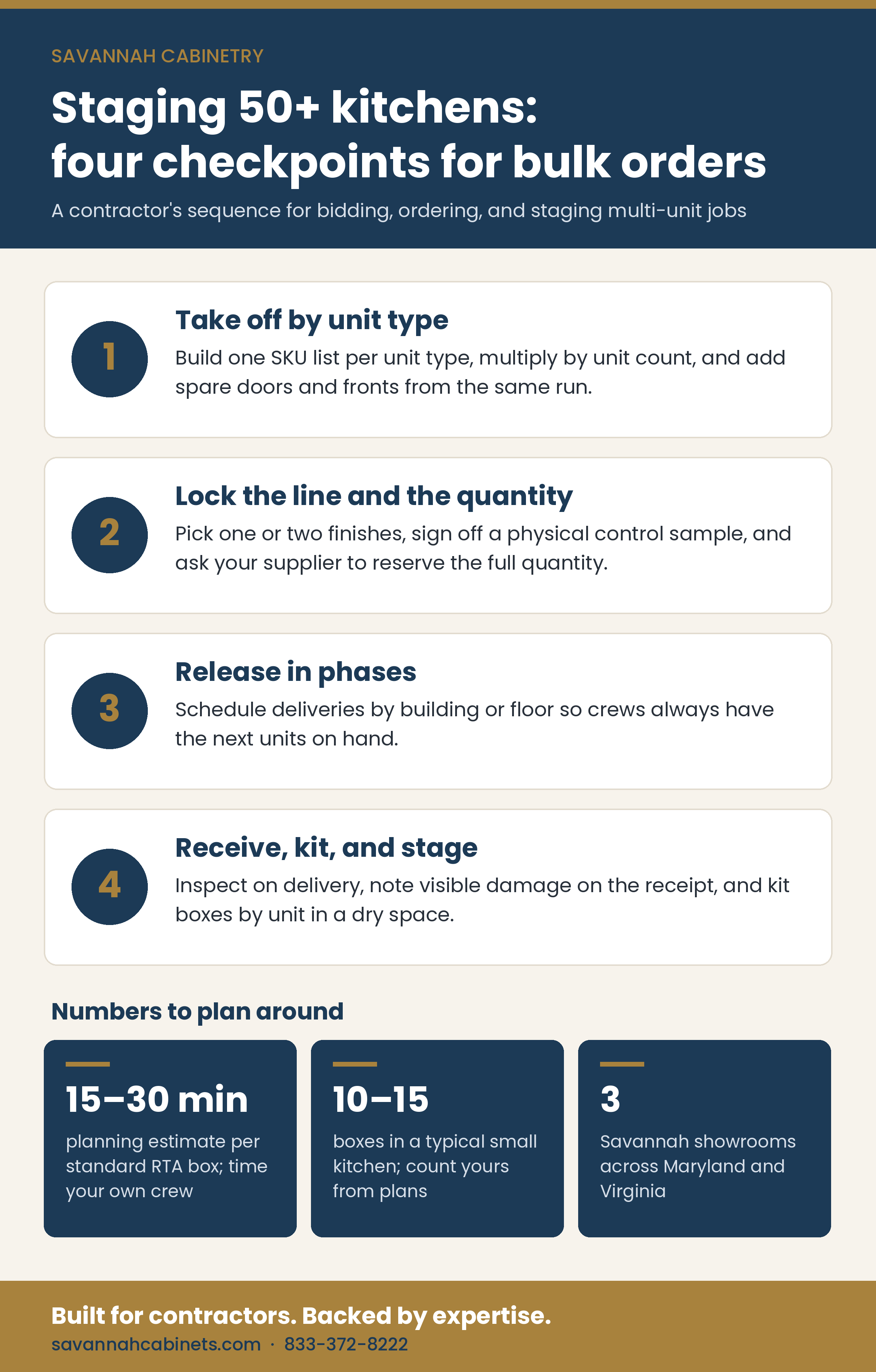
Phased deliveries vs. one bulk drop: staging on site
It depends on your site. Mostly on whether you've got dry, locked space and how the crews are sequenced.
One big drop. Everything lands at once. Fewer freight charges, one batch, no wondering whether the next truck shows. But now every carton is your problem until it's hung. That's fine when the building's dried in or there's a warehouse down the road. On an open site, it's asking for trouble.
Phased. A building at a time, or a few floors, timed to install. Less sitting around and less handling. You pay more in freight, and you're exposed if something sells out between releases.
What usually works. Lock the full quantity and the price at award, then pull it in phases. That holds for most wholesale cabinets for apartment renovations as well as new builds. It only works if your supplier can actually hold the job, so get the reservation and the price lock in writing before you count on them. Ask how much stock they carry in your lines and how long they'll hold it.
Staging checklist for multifamily kitchen cabinets
- Book deliveries for when you've got people on site and a pallet jack or forklift. LTL drivers generally lower the pallet at the tailgate and leave.
- Check every delivery before the driver pulls away. Count it against the bill of lading. Anything damaged goes on the delivery receipt and gets photographed.
- Get the cartons open soon. Hidden damage has a reporting deadline, and it's your supplier's deadline that counts. Some are short. One supplier we looked at allows five days.
- Pallets, not bare slab. Keep it dry, and only stack as high as the carton allows.
- Kit by unit when it arrives. When the crew walks into 214, everything for 214 should already be sitting there.
Working out a release plan?
Savannah keeps 250+ containers of RTA inventory. Schedule a Call with the unit count and install sequence, and we'll go over what's in stock in your lines and what a phased delivery schedule could look like.
RTA vs. assembled: crew time per unit
RTA cabinets ship flat. Freight is cheaper, they take a fraction of the storage space, and one guy can carry a box up a stairwell. What you give up is assembly time. On one kitchen nobody cares. On 60, it belongs in the bid.
How long per box? The numbers you'll see from manufacturers and trade sites mostly say 15 to 30 minutes for a standard wall or base cabinet. Plan with it. Don't treat it as a production rate. A new guy can spend 30 to 60 minutes on his first couple, and a tall pantry or a drawer base always runs long. After a few hundred, a decent crew sits at the bottom of that range, sometimes under it.
Here's an illustrative example. Call it 12 boxes for a small apartment kitchen. Most land somewhere from 10 to 15. At 20 minutes each you're near 4 crew-hours a kitchen, and around 240 hours over 60 units, all before anything's hung. Box construction changes that. So does who's on the crew and how many drawer bases are in the mix. Time the first few kitchens and adjust the bid math from there.
Set up an assembly station
On production work, don't let installers build their own boxes unit by unit. Pick a garage or an empty unit. Put one or two people there building ahead of the install crew.
Installers never stop hanging cabinets, and the builders get quicker every day. Bringing on a new helper? Savannah's Assembly Videos will get them through the box construction faster than you explaining it twice.
When assembled boxes make sense
Pre-assembled skips the labor. You pay for it in freight and storage, and in handling on site. It's worth it when you can't get the labor, the schedule's got zero float, and there's honestly room to put them. On a walk-up with no elevator, think twice.
Decision guide
A quick gut check while you're setting up the cabinet package.
| Priority | Go with | Why |
|---|---|---|
| Protecting margin on the bid | A unit-type takeoff with freight, assembly, handling and spares broken out | If it isn't a line item, it comes out of your fee at closeout. |
| Lowest material cost per unit | RTA in one standard line | Flat-pack freight costs less. Fewer SKUs keeps the quote short. |
| Finish consistency across units | One or two lines, full quantity on as few orders as possible, a signed control sample on site | Drift mostly happens batch to batch. Cut the batches. |
| Avoiding stockouts mid-job | A supplier with deep in-stock inventory and the full quantity reserved at award | Nothing sells out from under you between building one and building four. |
| Limited storage on site | Phased releases against a locked quantity and price | You keep the price and the lot without parking 400 cartons on site. |
| Tight labor or a short schedule | A dedicated assembly station feeding the install crew | Installers stay on the wall. Builders stay a unit ahead. |
| Walk-ups or no freight elevator | RTA | Flat cartons go up stairs. Try that with an assembled 42-inch wall cabinet. |
| Fast punch and warranty fixes | Spares on the main order | They'll match. A door you order a year later might not. |
Planning cabinets for a multi-unit project?
Get your takeoff ready for pricing. Register as a Savannah contractor and we'll talk through product options, quantities and delivery requirements for your job.
FAQ
-
Do contractors get better pricing on bulk kitchen cabinets?
It depends on who you're buying from and how big the job is, though volume tends to help. Register as a Savannah contractor and send the takeoff, and the quote gets built on your real quantities.
-
How many cabinets are in a typical apartment kitchen?
A small one is usually somewhere around 10 to 15 boxes. Layouts vary a lot, though, so count from your plans by unit type.
-
How long does it take to assemble RTA cabinets on a production job?
Expect published figures around 15 to 30 minutes for a standard box, more for talls and drawer bases. Plan with that, then time your own crew on the first few kitchens.
-
Should I take one bulk delivery or phased deliveries?
If you've got dry, secure space for all of it, one drop is simplest. If not, reserve everything at award and release it in phases that follow your install sequence.
-
How do I keep finishes matched across 50+ kitchens?
Fewer lines and fewer orders. Keep a signed sample door on site to check deliveries against, and get spares on the original order so they match.
-
What should I do if cabinets arrive damaged?
Before you sign, write any visible damage on the delivery receipt and get photos. Then contact your supplier and follow their deadline for reporting concealed damage.
-
How far ahead should I order cabinets for a multi-unit job?
Start the conversation at award, not at rough-in. In-stock RTA can move quickly. What keeps you out of stockout trouble is confirming the quantities, and any hold, early.
-
How do I choose a bulk kitchen cabinet supplier for a multifamily project?
Start with whether their finishes stay consistent and whether they actually stock the lines you want. After that it's lead times, freight terms, replacement parts, and whether they'll handle several delivery phases on one job.
-
What information should contractors provide when requesting a bulk cabinet quote?
Send unit-type floor plans with counts, cabinet sizes and the finish you want. Add the delivery address, project timeline and how you'd like deliveries phased.